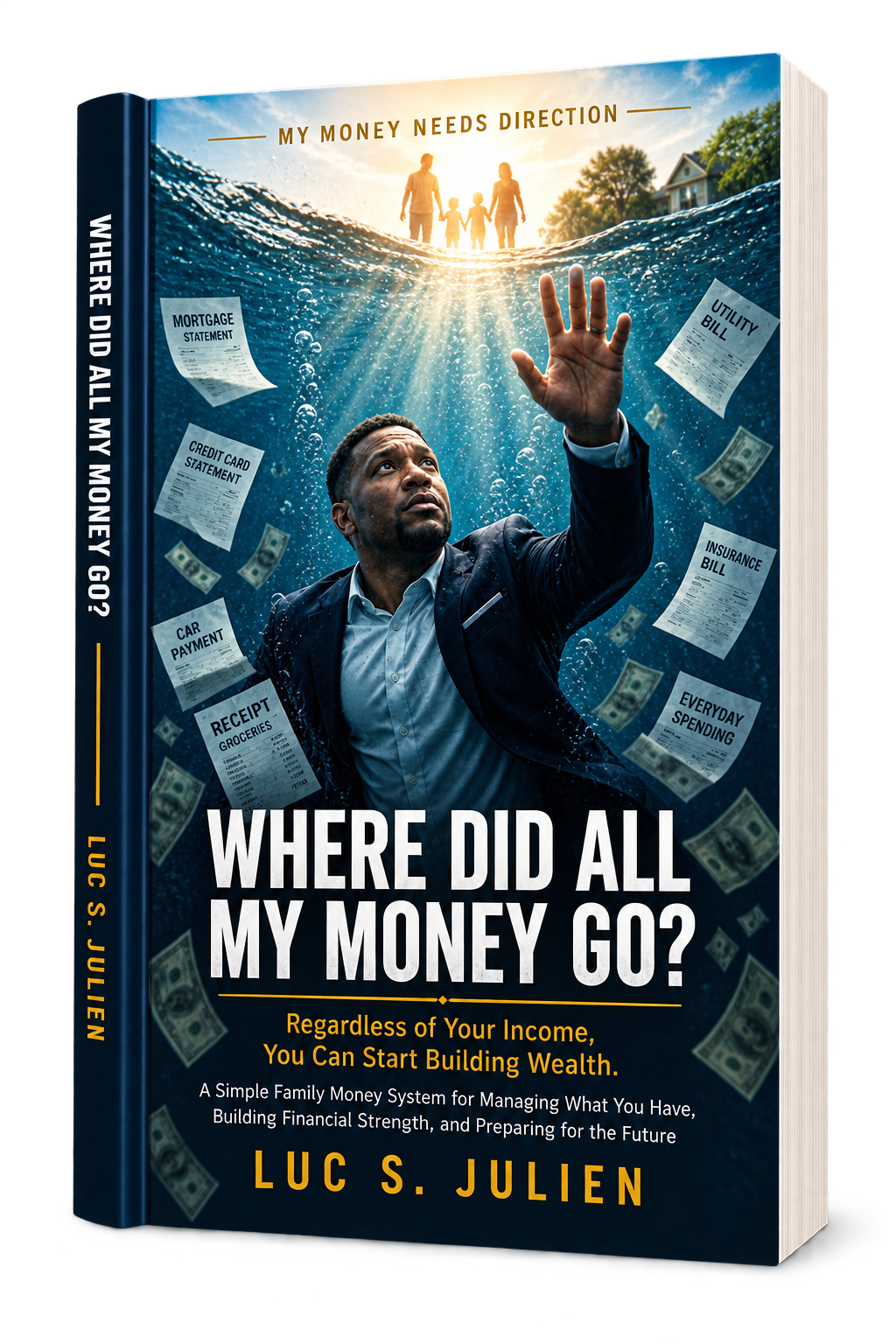
You pay the bills. You take care of your family. You try to make good decisions.
But somehow, there never seems to be enough left for everything you want your money to accomplish.
Maybe the problem is not only how much money you make.
Maybe your money needs more direction.
GET THE BOOKRegardless of your income, you can start building wealth.
Regardless of Your Income, You Can Start Building Wealth.
You may be doing many things right.
You work. You pay your bills. You take care of your family.
But when the month ends, you may still wonder:
Sometimes the problem is income.
But sometimes money comes in without a clear plan for what needs to happen next.
Housing, food, utilities, insurance, transportation, and everyday expenses can quickly compete for the same money.
A car repair, medical bill, home expense, or family need can change the entire month.
Saving, preparing for the future, and other family goals can feel harder when today's needs always come first.
A raise can help. But without direction, more money can disappear just as quickly as the money before it.
But more money without direction can disappear too.
More income can create more opportunity.
But if nothing changes about what happens after the money arrives, more income does not automatically create more progress.
That is why the first question is not only, “How much money do I have?”
A better question is:
What does this money need to do?Different dollars may need to handle different parts of family life. The goal is not perfection. The goal is clearer direction.
Imagine two families receive the same increase in income. What happens next depends on more than the amount.
The extra money feels like relief.
Life gets a little easier. A few expenses grow. A few upgrades happen. The additional money slowly blends into everyday life.
They feel the same relief.
But before changing their lifestyle, they pause. They talk about what needs attention and what some of the extra money should help accomplish.
Neither family is perfect. Neither family avoids the expense. The difference is that one family had already started giving some of the new money a purpose.
More money can create more room. But the amount alone does not decide what happens next.
The real shift begins when you stop looking only at how much money arrived and start deciding what that money needs to accomplish.
A family has more than one financial need. That means the money coming in may need to do more than one kind of job.
Use some money to help others, support causes you care about, or practice generosity.
Take care of everyday life, including housing, food, transportation, utilities, and family needs.
Prepare for disruptions, surprises, and the unexpected parts of real life.
Set money aside for future needs, larger goals, and greater financial stability.
Develop future knowledge, skills, capability, and opportunity.
Make room for fun, experiences, and the things that make life enjoyable.
You do not need to fund all six purposes every time money arrives.
You do not need six different bank accounts.
And you do not need a perfect percentage for every category.
The goal is clarity. Look at what needs attention and give the money you have a clearer direction.
You do not need another system that makes money feel harder than it already does. You need something simple enough to understand and practical enough to use.
This system does not ask you to fix your entire financial life overnight.
It helps you slow down, see what is happening, and decide what your money needs to do next.
Start where you are. Use what you have. Get clearer over time.
Understand where your money is going now.
Identify the areas that matter most right now.
Make a clear decision about what the money needs to do next.
The goal is not a perfect financial life. The goal is greater clarity, stronger habits, and better direction over time.
Understand where your money is going and what is getting your attention now.
Make decisions before the money quietly disappears into everyday life.
Give unexpected costs less power to erase every other financial goal.
Give your family a simpler language for talking about money and priorities.
Help children begin learning what money can do before they are making major financial decisions.
Take the next step without waiting for your income or financial life to become perfect.
You may still have bills. You may still have surprises. And you may still want to increase your income.
The difference is that the money you already have can begin moving with greater intention.
That is what financial direction looks like.The book gives you a simple structure for understanding your money, making decisions when money arrives, and helping your family build stronger habits over time.
GIVE. LIVE. PROTECT. BUILD. GROW. ENJOY. A simple way to think about what your money needs to do.
A repeatable routine for each time money arrives, so you can pause, decide, direct, and review.
START. STABILIZE. STRENGTHEN. BUILD. EXPAND. A non-linear way to understand progress without chasing perfection.
Simple ways to help children and teens understand money, choices, priorities, and responsibility.
Practical pages that help you move from reading to deciding, planning, and following through.
A simple way to begin using the system now without trying to change your entire financial life at once.
You do not have to master every part of the system at once.
Start where you are. Use the part that helps you most today, then build from there.
This book was written for everyday families who want more clarity, stronger habits, and a simpler way to make financial decisions.
You work hard, pay your bills, and still feel like progress is harder than it should be.
You do not want complicated rules. You want a system you can understand and actually use.
You may earn hourly pay, commissions, overtime, seasonal income, self-employment income, or a mix of different sources.
Maybe bills increased, debt became harder to manage, or life changed. You want a clearer place to begin.
Your income may have grown, but you want to make sure the additional money creates more direction instead of simply more spending.
You want your children or grandchildren to understand money earlier and make better decisions as they grow.
You can begin learning how to give clearer direction to the money you have today, while continuing to work toward the income and future you want.
Each part of the book builds on the last. You begin by understanding what is happening with your money, then learn how to give it clearer direction.
Understand why increasing income can help, but may not solve the whole problem when the money still has no clear direction.
Learn how to notice spending patterns, money leaks, and the small decisions that can quietly shape the month.
Learn a simple way to think about money through GIVE, LIVE, PROTECT, BUILD, GROW, and ENJOY.
Use the Payday Flow to slow down, see what needs attention, make decisions, and direct the money intentionally.
Learn why financial progress does not need to happen all at once and how small steps can become stronger habits.
Use age-based conversations to help children and teens understand choices, priorities, responsibility, and money earlier.
Think beyond leaving money behind. Learn how knowledge, habits, values, and financial understanding can also move forward.
Turn what you learned into action with a simple Quick Start designed to help you choose your next step.
Throughout the book, simple visuals and action pages help you turn ideas into decisions your family can actually use.
That is why the book combines simple explanations, real-life examples, visual frameworks, questions, and action pages throughout the system.
Children learn from what they see, hear, and practice. A family money system can help make those lessons clearer.
A financial legacy can include more than an account balance.
Children eventually make their own financial decisions.
Teaching them earlier can give them language and practice before the decisions become larger.
The goal is not to control their future.
The goal is to give them a stronger foundation for making choices of their own.
Families do not need perfect money conversations.
They need a place to begin and a simple language they can keep using as their children grow.
Build more than money. Build understanding.Start with a simple family money system you can understand, use, and build on over time.
A practical guide for families who want to understand their money, make clearer decisions, build stronger habits, and prepare for the future.
You need a system that helps you understand what is happening, decide what needs attention, and choose your next step.
You do not need to wait for the perfect income, the perfect month, or the perfect financial life. You can begin with what you have today.